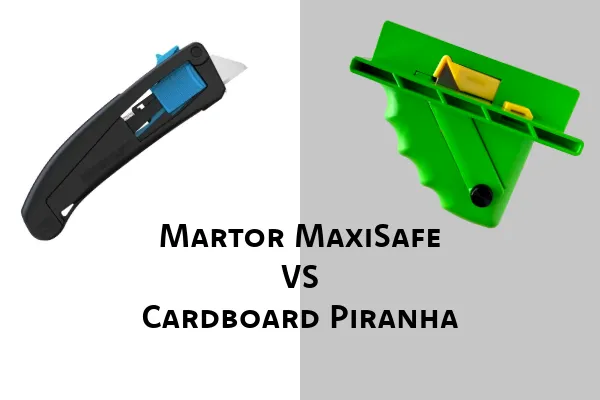
Martor Secupro Maxisafe v Cardboard Piranha vs. Cardboard Piranha
Comparing the cost of the Martor Secupro Maxisafe and the Cardboard Piranha safety box opener
Keeping workers safe while opening boxes is a critical concern for warehouses and production lines. Two tools designed to minimize injuries are the Martor Secupro Maxisafe and the Cardboard Piranha. Both knives offer automatic blade retraction and ergonomic designs, but their purchase price and blade‑replacement costs differ significantly. This article examines the differences and calculates the total cost of ownership over various timeframes.
Product overview
Martor Secupro Maxisafe safety cutter
Construction and usability. According to Atesco Industrial Hygiene, the Secupro Maxisafe belongs to Martor’s “Smart Knife Technology” line. It features a durable polycarbonate handle that can be used by both right‑ and left‑handed operators. The cutter is designed for cutting materials such as cardboard up to 3‑ply, tapes, plastic strapping and layers of foil or paper.
Automatic blade retraction. The knife’s smart‑knife mechanism automatically retracts the blade when it loses contact with the cutting surface even if the user keeps the slider pushed forward. This feature reduces the risk of accidental cuts and is considered an advanced safety design.
Standard and optional blades. The Secupro Maxisafe comes with a blunt‑tip trapezoid blade (M60099) and can also use the sharper M99 trapezoid blade. Replacement blades are sold in packs; one supplier lists ten Martor Trapezoid blades for US $8.50 per pack (about US $0.85 per blade).
Tool price. Pricing varies by configuration. A U.S. distributor lists the Secupro Maxisafe with metal cap for about US $18.39, while versions with rounded or pointed blades are around US $19.53. Models with ceramic blades cost more (about US $24.99). For this comparison, a mid‑range price of US $20 is used.
Cardboard Piranha safety box opener
Safety features. The Cardboard Piranha is marketed as a safety box opener that combines an ergonomic one‑handed design with an active safety mechanism. Its description notes that the Piranha is the only knife with an active safety guard. The guard keeps the blade covered until pressure from the box releases it, and it snaps back when the cut finishes.
Design and usability. The Piranha’s movable guard release eliminates the need to hold down a button while cutting and allows the knife to be used comfortably by warehouse workers. The handle stores up to five spare blades.
Price and blade cost. The manufacturer’s site lists the tool at US $39.97 with discounts available. It uses standard single‑edge razor blades that can be purchased from industrial suppliers; packs of 100 blades cost around US $13.67, or about US $0.14 per blade. To be conservative, this comparison uses a US $0.10 per blade estimate.
Cost assumptions
To compare total cost of ownership, the following assumptions are applied:
Workday and blade changes. Each tool is used for 8‑hour days, and the blade is replaced every 2 hours (four blades per day). The blade change frequency is the same for both knives.
Timeframes. Costs are calculated for 5 days, 10 days, 1 month (30 working days) and 2 months (60 working days).
Tool prices. The Secupro Maxisafe handle cost is taken as US $20 (approximately mid‑range of the various versions). The Cardboard Piranha handle cost is US $39.97 with discounts available.
Blade prices. Replacement blades for the Secupro Maxisafe cost US $0.85 per blade (US $8.50 for a 10‑pack), and Cardboard Piranha blades cost US$0.10 per blade.
One‑time purchase of the tool; the handle is not replaced during the study period.
Cost comparison over time
The table below summarizes the total cost for each tool over the specified timeframes.

Discussion
Initial cost. The Secupro Maxisafe handle costs roughly half as much as the Cardboard Piranha, making it attractive when the tool may be lost or damaged and blades are used sparingly.
Blade cost. The Secupro Maxisafe’s trapezoid blades cost about US $0.85 each, while the Piranha uses inexpensive razor blades that cost around US $0.10 each. Because blades are replaced four times per day, blade costs drive the long‑term expense.
Break‑even point. At five days, the Secupro Maxisafe is less expensive ($37.00) than the Piranha ($41.97). However, after ten days, the Piranha becomes cheaper ($43.97 vs. $54.00), and the cost gap widens over longer periods. After two months, the Secupro Maxisafe’s total cost (~$224.00) is more than triple that of the Piranha (~$63.97).
Safety and performance considerations. The Secupro Maxisafe offers fully automatic blade retraction even if the user holds the slider forward, which may be beneficial for users who override manual retracting knives. The handle is durable and ambidextrous. The Piranha’s active safety guard and movable guard release provide a different approach to safety, keeping the blade covered until contact with the box**. It also stores spare blades in the handle.
Conclusion
Both the Martor Secupro Maxisafe and the Cardboard Piranha provide advanced safety features and ergonomic designs. When considering total cost of ownership, the decisive factor is the price of replacement blades. The Secupro Maxisafe has a lower up‑front cost, but its specialized trapezoid blades (~US $0.85 each) make it significantly more expensive to operate over time. The Cardboard Piranha, despite its higher purchase price, uses inexpensive razor blades (~US $0.10 each) and becomes more cost‑effective after about ten working days. Organizations should weigh these cost considerations alongside each tool’s unique safety features when selecting a box opener for their workforce.
